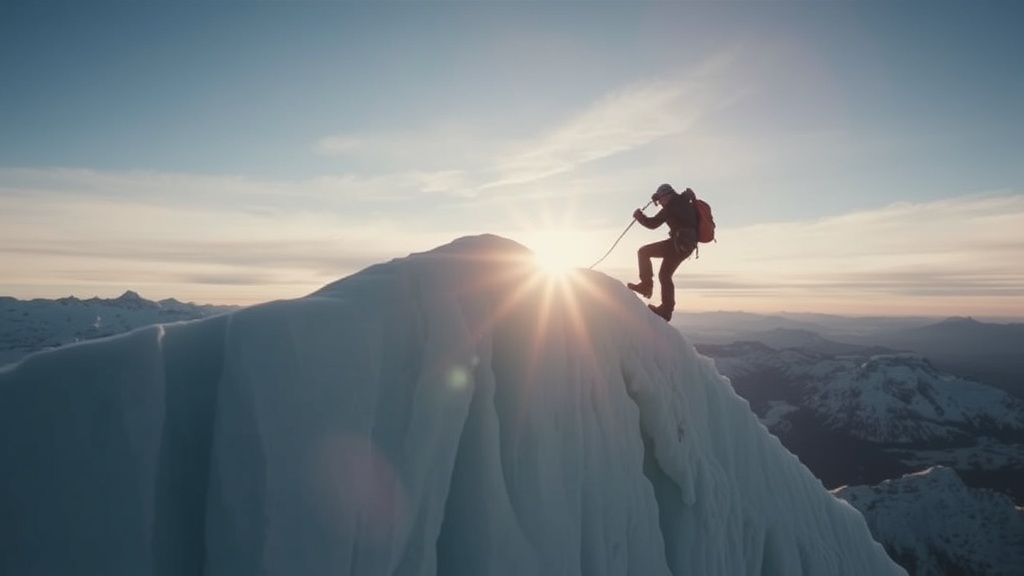
Why Your Core Collapses on Overhanging Ice — And How Rotational Strength Changes Everything
This post explains why traditional core training fails ice climbers on steep terrain, what rotational stability actually means for swinging ice tools, and specific exercises that transfer directly to better performance on vertical and overhanging ice. You'll learn the biomechanics of ice climbing movement and walk away with a practical training protocol you can start this week.
Why Do Ice Climbers Need Rotational Strength?
Most climbers think of their core as something that prevents their hips from sagging — a simple anti-extension function. On rock, that's mostly true. Your abs keep you close to the wall, you generate force through your legs, done. Ice climbing breaks this model entirely.
When you swing an ice tool, you're not just lifting your arm — you're creating rotational force through your torso. Your left hand swings, your right side has to stabilize. Your hips face the ice, but your shoulders rotate to reach the next placement. Every single movement on steep ice involves some degree of rotation, counter-rotation, or resisting rotation while maintaining tension.
Traditional crunches and planks don't prepare you for this. They're sagittal plane movements — straight forward and back. Ice climbing demands strength in the transverse plane, where rotation happens. When your obliques and deep core stabilizers aren't trained for this specific demand, they give out fast. You start swinging from your shoulder instead of your hips. Your feet cut. You barn-door. You pump out.
The research backs this up. A 2019 study in the Journal of Strength and Conditioning Research found that rotational medicine ball throws correlated more strongly with climbing performance than traditional core endurance tests — specifically on overhanging terrain where rotational demands peak. The study suggests that rotational power, not just core endurance, separates advanced climbers from intermediate ones.
What Happens When Your Core Can't Resist Rotation?
Picture this: you're on a steep pillar of chandelier ice, maybe 80 degrees. Your left tool is sunk solid above your head. You need to swing your right tool up and across your body to reach the next good placement. Sounds simple — except your core has to transfer force from your planted left foot through your hips, across your torso, and out through that swinging shoulder.
If your obliques and quadratus lumborum can't stabilize against that rotational force, your hips open toward the right. Your left foot pops. Now you're hanging on one arm, fully extended, trying to regain your foothold. You've gone from a controlled movement to a desperate one — and your forearms are paying the price.
This pattern shows up constantly in ice climbing. Watch someone struggle on steep ice and you'll see their hips swinging side to side, their torso twisting with each swing, their feet cutting constantly. It's not a grip problem — it's a core stability problem. The climber is leaking power through their midsection because they haven't trained to resist rotation under load.
The fix isn't more planks. It's training your core to function the way it has to on the ice — as a rotational stabilizer and force transfer system. You need exercises that challenge your ability to maintain a stable torso while your limbs generate force. You need to train anti-rotation, controlled rotation, and rotational power as separate qualities.
How Should You Train Rotational Strength for Ice Climbing?
Here's a three-phase approach that builds rotational capacity progressively. Each phase lasts 3-4 weeks. Start wherever your current strength allows — if you can't maintain form in phase one, don't advance to phase two.
Phase One: Anti-Rotation Foundation
Before you can rotate powerfully, you need to resist rotation. These exercises teach your core to stay stable when force tries to twist your torso.
Pallof Press: Stand perpendicular to a cable machine or resistance band anchor at chest height. Hold the handle at your sternum with both hands, elbows tucked. Press your hands straight forward, fully extending your arms without letting your torso rotate toward the anchor point. Bring them back to your chest. The goal isn't speed — it's total stillness through your hips and shoulders. Do 3 sets of 12 reps per side, 2-second hold at full extension.
Single-Arm Farmer's Carry: Grab a heavy dumbbell or kettlebell in one hand. Walk 40 meters, keeping your shoulders level and your torso upright. Don't let the weight pull you into lateral flexion or rotation. The heavier, the better — as long as you stay perfectly vertical. Do 3 carries per side.
Phase Two: Controlled Rotation
Now you're adding intentional rotation — but under control, with your core engaged throughout the movement.
Half-Kneeling Cable Chop: Kneel with one knee down (90 degrees) and the other foot planted. The cable machine should be set high on the same side as your down knee. Pull the handle down and across your body to your opposite hip, rotating through your torso but keeping your hips stable. The power comes from your core, not your arms. Do 3 sets of 10 reps per side.
Turkish Get-Up: This old standby covers every plane of motion, but the rotational component comes when you sweep your leg through and transition from the elbow to the hand. Go light — 35-45 pounds is plenty for most climbers — and focus on smooth, controlled movement. Do 3 sets of 3 reps per side.
Phase Three: Rotational Power
These movements develop explosive rotational strength — the kind you need for snapping quick, efficient swings on desperate ice.
Rotational Medicine Ball Throws: Stand perpendicular to a wall, holding a 10-15 pound med ball at your outside hip. Rotate through your torso and throw the ball into the wall, catching it on the rebound. The power should come from your hips and core, not your arms. Do 3 sets of 8 throws per side.
Cable Rotational Row: Set a cable machine at mid-torso height. Stand perpendicular, grab the handle with both hands, and explosively pull it across your body while rotating your torso. Control the return. This mimics the pulling motion of setting an ice tool while rotating into the ice. Do 3 sets of 8 reps per side.
Run this program twice weekly, ideally on days when you're not climbing or doing heavy pulling work. Recovery matters — these exercises stress tissues in ways most climbers aren't used to. Start conservative.
What About Breathing and Core Tension?
There's one more piece most climbers miss: breathing mechanics. On hard ice, you need to maintain high core tension while still breathing efficiently. Most people hold their breath — which works for a few seconds, then sends your heart rate through the roof and destabilizes your torso.
Practice the 360-degree breath. Lie on your back with your knees bent. Place one hand on your chest and one on your belly. Inhale through your nose for 4 seconds, expanding your ribcage laterally — your belly hand shouldn't rise much, but you should feel your sides pushing into the floor. Exhale through pursed lips for 6 seconds, engaging your deep core.
Once you can do this supine, practice it while holding a front plank. Then progress to the Pallof press position. The goal is maintaining that 360-degree core pressure while generating or resisting force — exactly what you need on steep ice. REI's climbing breathing guide offers additional techniques for managing respiratory stress on technical terrain.
When Should You Start Seeing Results?
Rotational strength adapts relatively quickly — faster than maximal finger strength, slower than endurance. Most climbers notice improved stability on steep ice within 3-4 weeks of consistent training. The telltale signs: your hips stay closer to the ice, your feet cut less, your swings feel more connected to your lower body.
Don't expect miracles on your first session back. The real test comes when you're tired — hour two of a long day, that final pitch before dark. That's when a stable core separates controlled climbing from survival mode. The climber with trained rotational strength keeps moving efficiently. The climber without it starts swinging harder, breathing faster, falling apart.
Start with phase one this week. Film yourself on a steep ice route — pay attention to hip movement and torso rotation. Train for three weeks. Film yourself again. The difference will be obvious — to you, and to anyone watching.
For more training science specific to climbing performance, TrainingBeta's research-based programming covers periodization and energy system development for technical climbing.