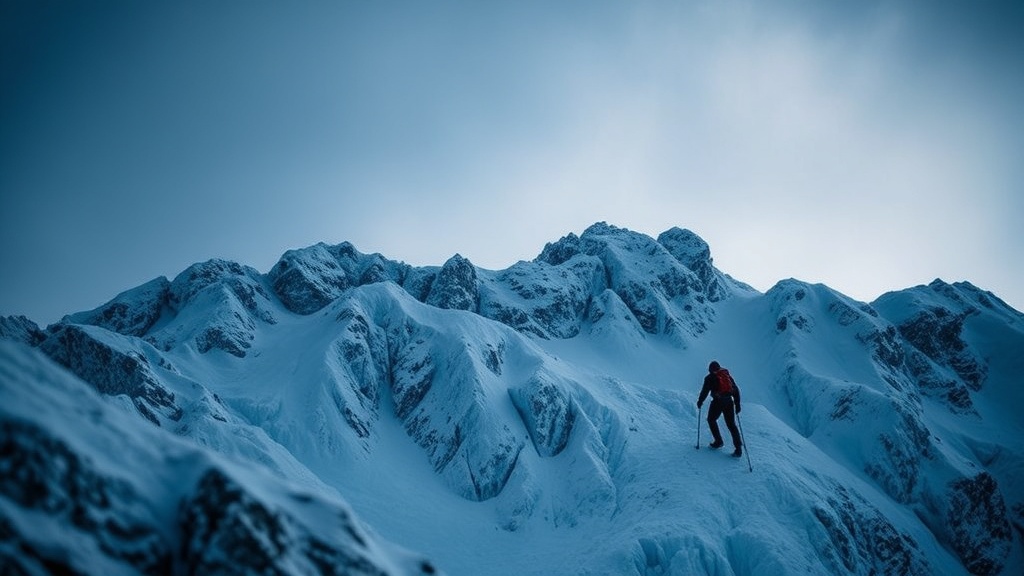
What Happens to Your Breathing at Altitude—and Why It Destroys Your Ice Climb
Why does every pitch feel twice as hard once you gain elevation?
If you've ever swung tools on a high-altitude ice route and found yourself gasping halfway up what should've been a comfortable grade, you're not alone. The thin air at elevation doesn't just make things "harder"—it fundamentally changes how your body processes oxygen, distributes blood, and generates power. This guide breaks down the physiological chaos altitude creates in your system—and more importantly, what you can do about it before your next trip to the high mountains.
How does altitude affect oxygen delivery to working muscles?
At sea level, oxygen makes up about 21% of the air you breathe. Climb to 3,000 meters (around 10,000 feet) and that percentage stays the same—but the partial pressure of oxygen drops significantly. Think of it like drinking through a straw that's suddenly half as wide. You're still getting oxygen, but not enough to fuel sustained physical output.
Your muscles—particularly the small stabilizers in your shoulders and forearms that keep ice tools planted—are extraordinarily demanding when it comes to oxygen. When the partial pressure drops, those muscles switch from aerobic metabolism (efficient, using oxygen) to anaerobic glycolysis (inefficient, producing lactate). That's why the same WI4 pitch that felt casual at the local crag becomes a desperate pumpfest at 4,000 meters.
The body attempts to compensate through several mechanisms. Your heart rate increases to push more blood volume. Your breathing rate accelerates. You start hyperventilating slightly—blowing off carbon dioxide faster than normal. These compensations work, kind of, but they come at a cost: increased fatigue, impaired judgment, and that shaky feeling in your calves when you're trying to stand on frontpoints.
The acclimatization timeline most climbers ignore
Here's what the research actually shows: meaningful acclimatization takes time—more than most weekend warriors allocate. According to the National Center for Biotechnology Information, ventilatory acclimatization begins within hours of altitude exposure but requires days to weeks for full effect. Red blood cell production—which actually increases oxygen-carrying capacity—doesn't ramp up significantly for two to three weeks.
This means arriving at a high-altitude ice destination the night before your first objective is a recipe for underperformance. You're climbing in a compromised state, whether you feel the altitude immediately or not. The climbers who consistently send at altitude aren't necessarily fitter—they're better acclimatized.
What training methods actually prepare you for thin-air climbing?
Intermittent hypoxic training gets a lot of attention, but the evidence is mixed. Some studies show benefits in sea-level performance after hypoxic exposure; others show minimal transfer to actual altitude climbing. What's more consistently supported is the value of aerobic base building at lower elevations combined with specific high-intensity intervals that mimic the demands of steep ice.
Here's a practical approach: spend your off-season building a massive aerobic engine through zone 2 training—long, steady efforts where you can hold a conversation. Running, cycling, skiing, whatever keeps you moving for hours at a sustainable pace. This isn't glamorous work, but it builds the capillary density and mitochondrial mass that becomes critical when oxygen is scarce.
Then, six to eight weeks before your altitude trip, layer in specific intervals: four to eight minutes at threshold effort, repeated four to six times, with two-minute recoveries. These intervals simulate the sustained, moderately high output of a multi-pitch ice route. The key is practicing controlled breathing during these efforts—deep, diaphragmatic breaths rather than shallow chest gasping. You're training the mechanics of efficient respiration, not just cardiovascular fitness.
Some climbers use altitude simulation systems—hypoxic generators or altitude tents—to pre-acclimatize from home. These can help, particularly for ventilatory adaptation, but they're expensive and logistically challenging. If you're serious about high-altitude ice, they're worth considering. For most recreational climbers, arriving at your destination early and sleeping at progressively higher elevations remains the most practical strategy. The Mountain Project community has extensive beta on acclimatization schedules for specific ranges.
How should you pace yourself differently at altitude?
Pacing is where the theory meets the ice. At sea level, you might climb a WI3 pitch at a steady, moderate pace—breathing rhythmically, placing gear methodically, conserving energy for the crux. At altitude, that same pacing strategy often fails because your recovery between moves is compromised. You can't catch your breath the way you normally would.
The solution is counterintuitive: slower, more deliberate movement with brief, intentional rests. Rather than climbing continuously and hoping to recover on the fly, build in micro-rests. Place a screw, hang on straight arms, take three to five deep breaths before committing to the next sequence. It feels inefficient. It isn't. You're preventing the accumulation of oxygen debt that derails so many altitude ice climbs.
Communication with your partner changes too. Simple commands take longer to process when your brain is slightly hypoxic. Establish clear, concise signals before you leave the ground. "Slack" and "tight" are better than multi-word requests. Non-verbal communication—tugging the rope in specific patterns—becomes valuable when wind or distance makes shouting impractical.
The hydration trap
One often overlooked factor: altitude increases respiratory water loss substantially. The dry, cold air you're pulling into your lungs strips moisture with every breath. Combine that with the diuretic effect of altitude (you pee more at elevation) and you've got a dehydration risk that impairs performance before you feel thirsty.
Force fluids—even when you don't want them. Start hydrating the day before your climb, not the morning of. Warm liquids are easier to consume in cold environments, so insulated bottles with electrolyte mixes beat cold water in your pack. The REI Co-op journal has solid practical guidance on hydration strategies for cold-weather mountaineering that applies directly to ice climbing.
When should you back off—even if the ice looks perfect?
There's a temptation at altitude to push through warning signs. The approach was long, the conditions are fleeting, and you've traveled far for this window. But altitude magnifies consequences. A pump that would be annoying at your local flow becomes dangerous when you can't think clearly enough to place protection properly.
Watch for the subtle signs of impaired judgment: difficulty with simple calculations (how many draws left on your harness), delayed reactions to partner communication, or a persistent headache that doesn't resolve with hydration. These aren't just inconveniences—they're your body telling you that oxygen delivery to your brain is compromised. Continuing upward in that state isn't commitment; it's poor risk management.
The climbers who survive long careers in the mountains develop what you might call altitude humility. They know their performance will degrade. They build that degradation into their decision-making. They accept that a WI5 project at sea level might become a WI4 challenge at 4,500 meters—not because the ice is different, but because they are.
Training for altitude ice climbing isn't about finding shortcuts or magic supplements. It's about understanding the physiological reality of thin air, respecting the time acclimatization requires, and adjusting your tactics accordingly. The mountain doesn't care about your fitness benchmarks. It cares whether you showed up prepared—for the elevation, for the cold, for the reality of performing with less oxygen than your body wants.
"The best ice climbers aren't the ones who never feel altitude. They're the ones who recognize it early and adapt their plans before the mountain forces adaptation on them."
Get high early on your next trip. Sleep at elevation before you climb. Move slower than your instincts suggest. Breathe deeper. And know that the pump you feel isn't weakness—it's your body doing exactly what it should do when oxygen is scarce. The question isn't whether altitude will affect you. It's whether you'll respect it enough to prepare properly.