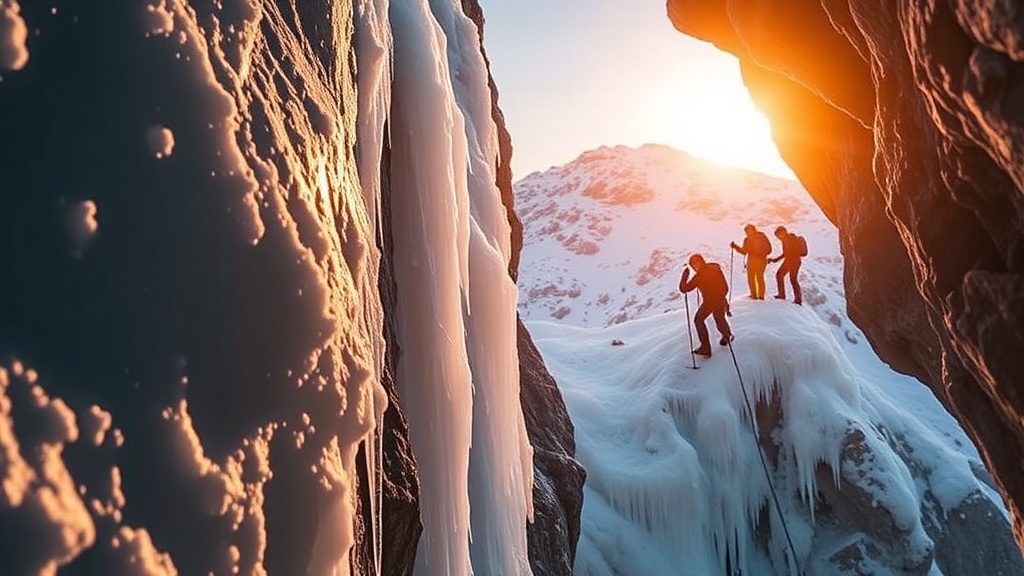
How to Train for Ice Climbing: Build Strength and Endurance for Vertical Ice

Ice climbing demands a rare combination of grip strength, cardiovascular endurance, and mental fortitude that few other sports require. This guide covers the specific training protocols—gym work, outdoor conditioning, and technique drills—that transform casual climbers into vertical ice specialists capable of tackling frozen waterfalls and alpine mixed routes. Whether you're planning your first trip to Ouray Ice Park or preparing for a technical alpine objective, the right preparation makes the difference between suffering through the experience and thriving in it.
What Muscles Should You Train for Ice Climbing?
The short answer: forearms, shoulders, and core—though not in the ways you might expect. Ice climbing taxes the entire posterior chain while placing unique demands on the grip and stabilizer muscles that standard gym routines often neglect.
Forearm endurance sits at the top of the priority list. Swinging ice tools for hours creates a relentless pump that ends climbs faster than technical difficulty ever will. The finger flexors—flexor digitorum profundus and superficialis—work overtime gripping tools while the extensors stabilize your wrist position with each strike. Here's the thing: standard barbell work won't build the specific endurance these muscles need.
Shoulder stability matters more than shoulder strength. Every swing places rotational stress on the rotator cuff, and the joint must absorb impact forces when tools stick or (more often) don't stick on the first try. The catch? Most climbers overtrain pressing movements and undertrain the external rotators and scapular stabilizers that prevent shoulder injuries.
Core strength in ice climbing differs from the six-pack-focused routines popular in fitness culture. You'll need anti-rotation stability—resisting the twist created by single tool placement—and the ability to maintain body tension while keeping hips close to the ice. Worth noting: the core work that transfers best to ice climbing rarely looks like traditional ab exercises.
Priority muscle groups for ice climbing:
- Forearm flexors and extensors (endurance-focused)
- Rotator cuff muscles (external rotation emphasis)
- Lower traps and rhomboids (scapular stability)
- Hip flexors and glutes (high-stepping power)
- Gastrocnemius and soleus (calf raises for front-pointing)
How Do You Build Grip Endurance for Ice Tools?
Grip endurance training requires high-rep, low-rest protocols that mirror the sustained nature of ice climbing—think sets of 15-20 reps with minimal recovery, not the low-rep strength work that builds maximum pulling power.
Hangboarding delivers the most specific forearm training available, but the protocol matters enormously. Use a Metolius Contact Hangboard or similar edge-based trainer—skip the jugs entirely. Start with dead hangs on 20mm edges: 10 seconds on, 5 seconds off, repeated 6 times per set. Rest 3 minutes between sets. Build to 4 sets, twice weekly, during the preparation phase.
Farmer's carries with fat grips transform standard gym work into climbing-specific conditioning. Wrap Fat Gripz (the blue Extreme model works best) around dumbbells or kettlebells, load 50-60% of body weight across both hands, and walk for 40-60 seconds. The catch? Don't set the weights down when the burn starts—that's exactly when the adaptation begins. Three sets after your main strength work builds the mental tolerance for forearm pump that ice climbing demands.
Wrist roller training isolates the endurance demands that compound movements miss. A simple PVC pipe with rope and weight plate costs under $15 to build and delivers brutal forearm-specific work. Roll up 15 pounds for 3-5 full up-and-down cycles, keeping arms extended at shoulder height. The pump arrives fast—and that's the point.
For those with access to ice tools year-round, dry-tooling on a rock wall builds the most specific grip endurance possible. Set three to four tool placements on an overhanging boulder problem and lap it until failure. Rest 5 minutes. Repeat 4 times. Nothing in the gym replicates the specific torque and vibration absorption that real tools require.
What's the Best Cardio Training for Ice Climbing?
Steady-state aerobic base combined with high-intensity interval work—though most climbers get the ratio wrong. Ice climbing demands bursts of anaerobic output (the crux sequence) followed by active recovery (shaking out on good ice), repeated for hours at altitude. That metabolic profile requires both energy systems working well.
Trail running with vertical gain builds the most transferable aerobic base. Find steep trails—800-1000 feet of gain per mile—and keep your heart rate in Zone 2 (conversational pace) for 60-90 minutes. The eccentric loading on descents also preps your quads for the quad-burning down-climbs that finish most ice routes. In the Burlington area, Mount Philo offers steep fire roads perfect for this training; west coast climbers should hit Mt. Si near Seattle or Grouse Grind in Vancouver.
Stairmill intervals develop the specific quad and calf endurance that front-pointing requires. Set the Precor StairClimber or similar machine to a challenging level—usually 8-12 for most athletes—and perform 3-minute intervals at a pace that pushes your heart rate to 85% max. Rest 90 seconds between intervals. Complete 8-10 rounds, once weekly, during the 8 weeks before your ice season starts. The movement pattern directly mimics the high-stepping motion of steep ice.
Loaded carries with a weighted pack prepare your cardiovascular system for the approach—often the crux of any ice climbing day. Load 25-30 pounds (water bottles work perfectly) into a Osprey Mutant 38 or similar climbing pack and hike steep terrain for 45-60 minutes. Don't neglect this: approaches to classic routes like Standard Route on Frankenstein Cliff or Black Dike on Cannon Cliff require serious grunt work before the climbing even begins.
| Training Method | Primary Benefit | Frequency | Duration |
|---|---|---|---|
| Zone 2 trail running | Aerobic base, recovery capacity | 2x weekly | 60-90 min |
| Stairmill intervals | Anaerobic power, quad endurance | 1x weekly | 30-40 min |
| Weighted pack hikes | Approach-specific conditioning | 1x weekly | 45-60 min |
| Cycling (road or mountain) | Active recovery, leg endurance | 1-2x weekly | 45-120 min |
Strength Training Protocols for Ice Climbers
Compound lifts form the foundation—but modified for climbing-specific demands. The goal isn't maximal strength (that's for boulderers); it's strength-endurance and injury prevention for long days in the mountains.
Pull-ups remain non-negotiable, though the rep scheme differs from standard strength programs. Use a Beastmaker 1000 or similar finger-friendly bar, and perform 5 sets to technical failure (stop before form breaks down). Rest 2 minutes between sets. If you can do more than 15 reps on the first set, add weight. If you can't do 5 reps with good form, use a resistance band for assistance—momentum-cheating pull-ups build bad movement patterns.
Overhead pressing protects shoulders better than the bench press most climbers favor. The KB Kings Competition Kettlebells work perfectly for single-arm overhead presses that build the unilateral stability ice climbing requires. Start with 16kg (men) or 12kg (women), progressing when you can perform 3 sets of 8 reps per arm with perfect form. The full range of motion—kettlebell touching the shoulder at bottom, bicep by the ear at top—matters more than the weight on the bell.
Deadlifts build the posterior chain power needed for high steps and tool placement. That said, conventional deadlifts aren't ideal for climbers. The trap bar (or hex bar) variation keeps the load centered and reduces shear forces on the lower back—important when you're carrying heavy packs on approaches. Work up to 3 heavy sets of 5 reps, once weekly, during the base phase. Drop to maintenance (1-2 sets) during the climbing season.
Single-leg Romanian deadlifts address the balance and stability that ice climbing demands. Stand on one leg, holding dumbbells or kettlebells, hinge at the hips while keeping the back leg extended. Three sets of 10 reps per leg, twice weekly, builds the hamstring and glute strength that powers front-pointing technique. Worth noting: these look easy but humble even strong athletes when performed with control.
How Can You Train for Ice Climbing at Home?
You don't need a full gym or ice crag to prepare effectively—though some creativity and discipline helps. A minimal equipment setup plus consistent execution often beats sporadic access to fancy facilities.
The living room hangboard routine requires only a mounted board and 20 minutes. Morning or evening—consistency beats timing. After a thorough warm-up (jump rope, arm circles, light stretching), perform: 6 sets of 10-second hangs on the 20mm edge, 3-minute rest; 4 sets of 7-second hangs on the 15mm edge, 3-minute rest; finish with 3 sets of maximum-duration hangs on the 30mm jug (for active recovery). Three sessions weekly builds remarkable finger endurance in 8 weeks.
DIY ice tool training creates specific movement patterns without real ice. Bolt a pair of retired ice tools (or even rock hammers) to a wooden board, hang it from a pull-up bar, and practice the swing mechanics. Focus on the wrist flick and follow-through—not power, but precision. Ten minutes of deliberate practice daily ingrains the movement pattern that makes efficient climbing possible.
Yoga for climbers isn't about flexibility—it's about body awareness and breath control. The YogaGlo platform offers specific "climber's yoga" classes that target hip openers (for high steps), shoulder mobility (for tool placement), and breath work (for fear management on lead). Two 30-minute sessions weekly complement the strength work without adding recovery burden.
Visualization training might sound soft, but the research on motor learning is clear: mental rehearsal activates the same neural pathways as physical practice. Spend 10 minutes visualizing perfect ice climbing movement—tool swing, ice evaluation, efficient foot placement, smooth upward progress. Elite climbers at Ouray and Hyalite Canyon use this technique extensively. The mind doesn't fully distinguish between vivid imagination and reality, so rehearse success, not fear.
"The best ice climbers aren't necessarily the strongest—they're the most prepared. Training builds the physical foundation, but consistency builds the climber." — Will Gadd, professional ice climber and author of Ice & Mixed Climbing: Modern Technique
Putting It Together: A Sample Training Week
Periodization matters. The 12 weeks before ice season break into three phases: Base (weeks 1-4), Build (weeks 5-8), and Peak (weeks 9-12). Here's what a Build phase week looks like for an intermediate climber:
Monday: Strength — Pull-ups, overhead press, deadlifts, single-leg RDLs. Finish with 10 minutes wrist roller work.
Tuesday: Cardio — 75-minute Zone 2 trail run with 1,500 feet vertical gain.
Wednesday: Active recovery — 30 minutes yoga, 10 minutes visualization, light walking.
Thursday: Strength — Same as Monday, substituting weighted carries for deadlifts. Finish with hangboard protocol.
Friday: Cardio — Stairmill intervals, 8 rounds of 3 minutes hard / 90 seconds easy.
Saturday: Long weighted pack hike, 90 minutes with 30-pound load. Practice layering systems for temperature management.
Sunday: Complete rest or light movement (walking, easy cycling). Recovery enables adaptation—don't skip it.
The Peak phase drops strength volume by 30% while maintaining intensity, shifts cardio toward interval emphasis, and adds specific technique work on plastic (if available) or dry tooling. Two weeks before your first ice climbing trip, taper—reduce volume by 50%, maintain intensity, arrive fresh rather than fatigued.
Training for ice climbing demands patience and specificity. The general fitness that serves road runners or CrossFit athletes won't transfer to vertical frozen water. Focus on the forearm endurance that lets you swing tools for hours, the shoulder stability that prevents the injuries that end seasons, and the cardiovascular capacity that keeps you moving efficiently at altitude. Start 12 weeks before your first ice trip, progress gradually, and trust the process. The ice will be there—make sure you arrive ready for it.
Steps
- 1
Build Grip and Forearm Strength with Hangboard Training
- 2
Practice Tool Placement Technique on Dry Land
- 3
Develop Core Stability and Crampon Footwork