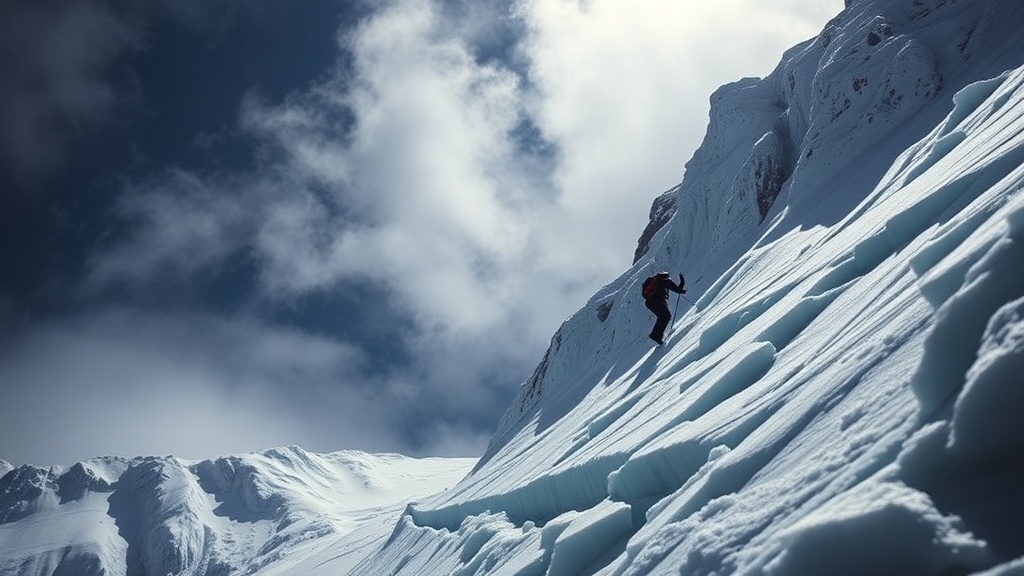
How to Train Efficient Movement Patterns for Steep Ice Routes

What You'll Learn: Building Fluid, Efficient Movement for Vertical and Overhanging Ice
This post covers a systematic approach to developing movement efficiency on steep ice—exactly where climbers burn the most energy and pump out fastest. You'll learn how to sequence your tools and feet to reduce arm fatigue, how to train these patterns on the ground, and how to apply them when the angle kicks back. Whether you're projecting WI5 or looking to conserve energy on long alpine ice, these techniques will change how you move.
Why Do My Arms Pump Out So Fast on Steep Ice?
The answer usually isn't strength—it's poor movement sequencing. On vertical terrain, climbers often default to pulling with their arms rather than pushing with their feet. This habit feels natural because the ice axes provide immediate security, but it drains your forearms within minutes.
Efficient ice climbing relies on the same principle as rock climbing: your legs do the work, your arms hold position. The difference? Ice tools swing and stick unpredictably, which creates hesitation. That pause—with your arms fully engaged—destroys your endurance. The fix is training specific movement patterns until they become automatic, eliminating the hesitation that burns matches.
Start with the basic "triangle of support" concept. At any given moment, three of your four points of contact (two tools, two feet) should form a stable base while the fourth moves. The key is never moving a tool and a foot on the same side simultaneously—this creates a diagonal instability that forces you to pull harder with your arms. Instead, practice the "crossover" pattern: left tool moves while right foot moves, then right tool with left foot. This maintains opposition and keeps your hips close to the wall.
How Can I Practice Ice Movement Without Being on Ice?
You don't need a frozen waterfall to train efficient patterns. A climbing gym's dry tooling boards—or even a system board with wooden holds—let you rehearse the same movement sequences that apply on ice. The goal isn't simulating the exact conditions; it's drilling the neuromuscular patterns until they become your default.
Set up a simple drill on any overhanging wall. Place two tools at shoulder height, then add footholds slightly below and wider than your hips. Now climb in slow motion: place a tool, shift your hips over the corresponding foot, then move the opposite foot up before placing the next tool. Each sequence should take ten full seconds. Count it out loud. If you can't move slowly with control, you're not stable—you're muscling.
Add the "no-readjustment" rule. When you place a tool or foot, it stays there. No micro-adjustments, no "just making sure." This forces you to commit to positions and accept minor imperfection. On real ice, every second spent fiddling with a placement is a second your forearms are fully contracted. Train decisiveness on plastic, and you'll save energy on ice.
For those without gym access, a simple home setup works. Mount two ice tool replicas (or even heavy hammers) to a pull-up bar, add a foot stool or boxes, and practice the same slow-motion sequencing. It's not about the grip—it's about the coordination. TrainingBeta's guide to dry tooling offers additional drills you can incorporate.
Building Hip Mobility for Ice-Specific Positions
Steep ice demands high steps and wide stems—positions that require hip flexibility most climbers neglect. Tight hip flexors force you to sag away from the wall, increasing the load on your arms dramatically. The solution is targeted mobility work, not generic stretching.
Focus on "couch stretch" variations for your hip flexors and "90/90" switches for internal and external rotation. Spend two minutes per side daily. The goal isn't extreme flexibility—it's functional range that lets you keep your hips tucked close to the ice when you're front-pointing on vertical terrain. Uphill Athlete's hip mobility protocol provides a progressive program specifically designed for mountain sports.
What Specific Drills Build Automatic Ice Technique?
Pattern recognition happens through repetition. These three drills—performed on dry tooling boards or moderate rock routes—build the automatic responses you need when fatigued on lead.
Silent Feet: Climb any route without making a sound when your feet touch the holds. This forces slow, controlled placement and full commitment to each position. When your foot sticks silently, you're stable. When it scrapes or thuds, you're not. Transfer this awareness to ice: your crampons should engage quietly and precisely.
Hover Hands: After placing a tool, hover your hand over the grip for three full seconds before weighting it. This builds the habit of securing your feet before committing your arms. On ice, this translates to planting your crampons solidly before reaching for the next placement.
One-Arm Hangs Between Moves: On a hangboard or juggy holds, climb while requiring yourself to hang one arm straight between each movement. This exaggerates the rest position and trains you to find moments of arm relaxation even while climbing. On steep ice, even a second of straight-armed hanging while your feet adjust saves glycogen.
How Do I Apply These Techniques on Actual Ice?
Training patterns in the gym is necessary but insufficient. Ice is irregular, conditions change, and the psychological pressure of leading changes everything. Here's how to bridge the gap.
Start on top-rope, even routes well within your grade. Focus exclusively on movement quality, not getting to the top. Set a timer: climb for five minutes without pumping out, regardless of how much vertical ground you cover. If you're fighting gravity with your arms, down-climb and try again. This builds the aerobic base for continuous movement.
Progress to "mock leading"—clipping the rope to fixed protection as you climb, but with the security of a top-rope backup. This introduces the mental load of decision-making while maintaining physical practice. The pump comes faster when your brain is busy, so this builds stress-proof technique.
When you do lead, pre-plan your rests. Identify features where you can drop one arm and shake out—the equivalent of the straight-armed hangs you trained. Chandeliers, mushroom features, or even decent foot placements on lower-angle sections become active recovery stations. This isn't cheating; it's energy management that separates climbers who send from climbers who bail. Mountain Project's forum discussions include real-world strategies from climbers who've applied similar approaches to hard ice routes.
Finally, study footage of efficient ice climbers. Watch how Will Gadd or Sarah Hueniken move—their hips stay close, their arms stay straight, their movements flow. Compare this to your own video (film yourself). The gap between efficient and inefficient movement is usually obvious once you see it. Most climbers have never watched themselves climb ice; the revelation is worth the awkwardness of setting up a camera at the crag.
The Role of Core Stability in Movement Efficiency
Your core isn't just for show on steep ice—it's the connection between your feet (which should be doing the work) and your shoulders (which hold your tools). A weak core forces you to bend at the waist, moving your hips away from the wall and increasing arm load by 30% or more.
Train core stability with exercises that resist rotation and extension: Pallof presses, dead bugs, and front levers (or progressions toward them). The goal isn't six-pack aesthetics; it's the ability to maintain a rigid body position while your limbs move independently. When your core is solid, your feet stay weighted even as you reach for the next swing.
How Long Until These Patterns Become Automatic?
Neuromuscular adaptation takes time—typically six to eight weeks of consistent practice before new movement patterns override old habits. The key is frequency over intensity. Ten minutes of deliberate practice three times per week beats an hour-long session once weekly. Your nervous system learns through repetition, not duration.
Track your progress with simple metrics: how long can you climb steep terrain before your forearms force you to stop? How many tool placements can you make in a minute on a set route (more isn't always better—quality matters)? When you notice the patterns clicking—when you place a tool and realize your arms weren't even pumped—that's the transition from conscious competence to unconscious competence. That's where you want to be when you're fifty feet out from your last screw, staring at a curtain of chandeliered ice.