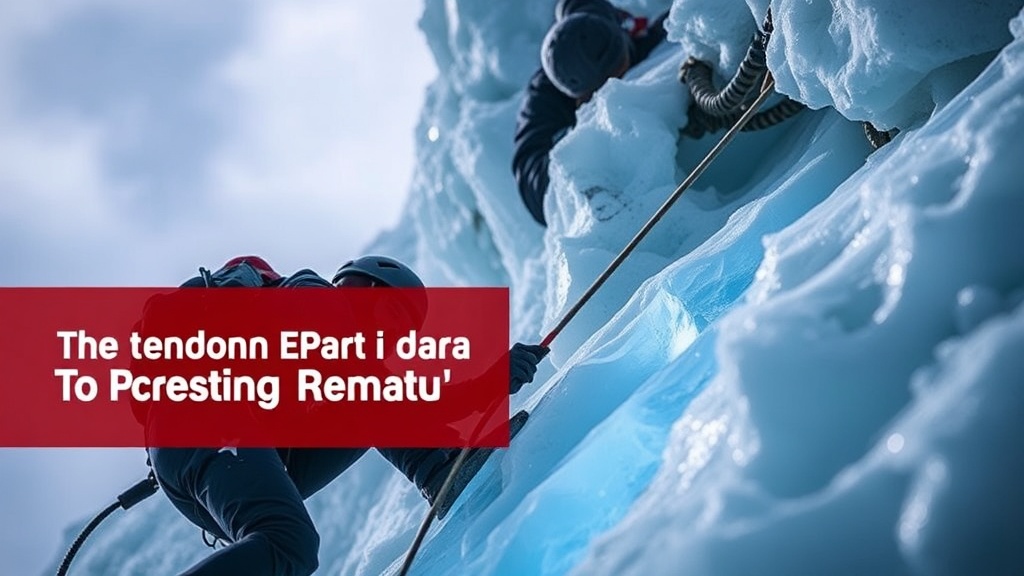
Developing Durable Tendons for Vertical Ice

Why Do My Tendons Feel Brittle on Vertical Ice?
Ever felt that sharp, nagging ache in your fingers or elbows after a heavy session on a technical ice pillar? It isn't just fatigue; it's often a sign that your connective tissue is struggling to keep up with the mechanical stress of tool swings and heavy tool placements. Ice climbing puts a unique kind of strain on the body—not just through repetitive impact, but through the constant tension of hanging from tools in sub-zero temperatures. If you don't build structural integrity in your tendons and ligaments, you're looking at long-term injury risks. This post covers how to build tendon durability through specific loading protocols and movement patterns.
Tendons are different from muscles. While muscles have a rich blood supply and adapt relatively quickly to training, tendons rely on slower metabolic processes. This means your strength gains might outpace your structural integrity if you aren't careful. We'll look at how to manage that gap so you can stay on the ice longer without needing a physical therapist on speed dial.
How Much Load Can Tendons Actually Handle?
The mistake most climbers make is thinking that more volume always equals more strength. In reality, tendons respond best to heavy, slow, and controlled loading. When you're swinging an ice tool, you aren't just moving a weight; you're absorbing the shock of the impact. This shock absorption happens through the kinetic chain, starting at the tool and moving through your wrists, elbows, and shoulders. If your tendons aren't prepared for that load, the vibration and impact can cause micro-tears.
To build durability, you need to incorporate heavy resistance training that emphasizes the eccentric phase (the lengthening of the muscle/tendon). For example, when doing weighted pull-ups or specialized grip work, focus on the lowering phase. This slow descent helps thicken the collagen fibers within the tendon. You can find more detailed biomechanical studies on tendon loading through the National Center for Biotechnology Information (NCBI) to understand the physiological basis of this work.
What Exercises Build Grip Strength for Ice Tools?
Grip strength in ice climbing isn't just about how much weight you can hang from a bar; it's about how well your hand-to-tool connection holds up under fatigue. You need to train the specific muscles that stabilize the wrist and fingers. Consider these three approaches:
- Isometrics: Holding a heavy weight or a hangboard edge for 30-45 seconds. This builds the ability to maintain tension over time.
- Heavy Isotonic Loading: Moving heavy weights through a full range of motion. This strengthens the entire forearm complex.
- Impact Management: Using a specialized tool-swing drill (on a training board or even a heavy bag) to get your body used to the vibration of a strike.
Don't forget that your grip strength is heavily influenced by your shoulder stability. If your shoulder is weak, your forearm muscles have to work twice as hard to keep your tool in place. Incorporating overhead presses or kettlebell work can provide a solid foundation for your grip. A stable shoulder means a more efficient transfer of energy from your swing to the ice.
Can You Prevent Tendonitis Through Training?
Preventing inflammation isn't just about resting when it hurts; it's about proactive loading. If you only train when you feel good, you'll never build the resilience needed for a full season. However, you have to be smart about it. If you feel a sharp, localized pain—rather than a dull, general ache—stop immediately. That's your body telling you that you've reached the limit of your current capacity.
One way to track this is by monitoring your "baseline discomfort." On a scale of 1 to 10, a 2 or 3 is often acceptable during training, but anything higher suggests you're pushing too hard. Use a journal to track how your joints feel after different types of sessions. This data is more valuable than any generic training program. For more general fitness guidelines and physical literacy, check out resources like Strength Training Day for structured lifting advice.
| Training Type | Primary Benefit | Frequency |
|---|---|---|
| Heavy Eccentrics | Tendon Thickening | 1-2x per week |
| Isometrics | Grip Endurance | 2-3x per week |
| Mobility Drills | Range of Motion | Daily |
It's also worth noting that nutrition plays a role here too. While this isn't a nutrition post, your body needs the right building blocks—like collagen and vitamin C—to actually repair the tissue you're stressing. If you're under-eating, your recovery will stall, no matter how good your training program is. Listen to your body, respect the slow pace of connective tissue adaptation, and you'll find yourself climbing harder, longer, and with much less fear of injury.